
Fiduciary-aligned contracts, ready for CAA 2026.
CAA 2026 codifies what fiduciary best practice already required: active oversight of PBM contracts. Contract X-Ray evaluates whether your contract is built to that standard, ahead of staggered effective dates running through 2029.
01 · What the first benchmark shows
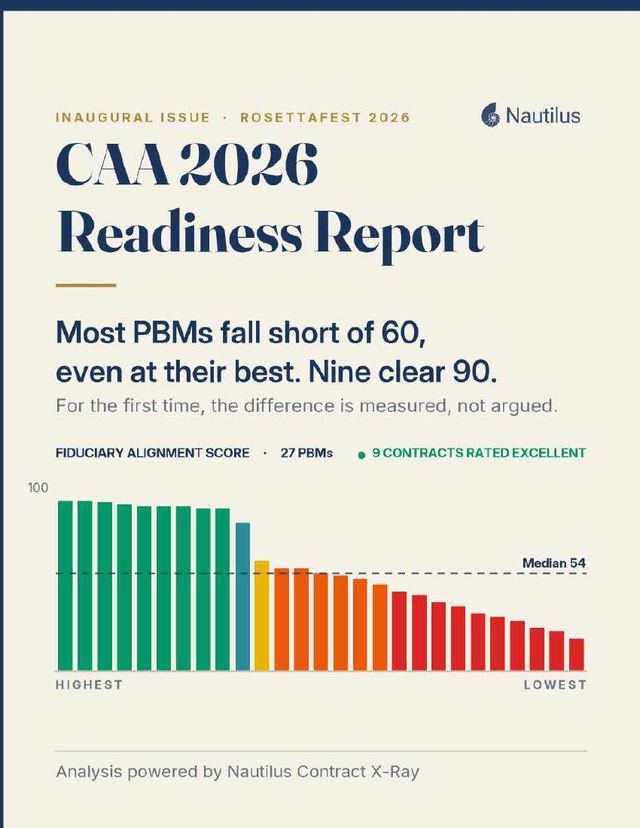
Most PBM contracts fall short of 60, even at their best. Nine clear 90.
Inaugural issue · Published July 29, 2026
CAA 2026 Readiness Report
For the first time, the difference is measured, not argued.
19 pages · No signup
Nautilus Contract X-Ray scored the standard contracts of 27 PBMs and 37 plan sponsor contracts against ten fiduciary provisions. Shawn Gremminger, President of the National Alliance of Healthcare Purchaser Coalitions, wrote the foreword. The report publishes quarterly from here.
Nine PBMs opened their standard contracts to independent scoring. All nine now rate Excellent, and not one of them started there. Two began in Red Flag, four in Concern, three in Fair. Each rewrote its contract to reach the standard, gaining 39 points on average, and six went through four or more rounds. Those nine form the first CAA 2026 Ready cohort.
How a PBM makes its money predicts almost everything. Transparent pass-through contracts average 92. Spread-priced contracts average 32. Of the 37 plan sponsor contracts scored, not one reaches Good.
If you are a PBM and want your standard contract scored for a future issue, learn more on the PBMs page or .
Every contract was scored on its language alone, by the same rubric. Inclusion reflects a PBM’s decision to open its contract to scoring. It is not an endorsement or a certification of the company. No PBM paid to be scored, to be remediated, or to be listed. The rating measures contract language, not conduct, price, or service.
02 · Why the law is the floor, not the ceiling
Fiduciary best practice. The law is the floor, not the ceiling.
There has never been a clear fiduciary standard for PBM contracts. ERISA and CAA 2021 set the obligations of loyalty, prudence, and diligence, but those are principles, not specifications. CAA 2026 and the DOL rule that implements it codify more of the framework. Specific requirements around rebate pass-through, spread pricing, audit independence, and fee disclosure are now law. But the fiduciary judgment about what is in the best interest of participants stays where it has always been: with the plan sponsor.
Plan sponsors have the latitude to do business with whomever they choose, under whatever terms they choose. There is no reason to wait for staggered effective dates, and no reason to contract only to what the statute requires. The law is the floor. A fiduciary-grade contract is the ceiling, and it includes statutory requirements, regulatory requirements, fiduciary safeguards that protect against identifiable risks, and best practices that make the work more achievable.
Most PBM contracts in force today were written by PBMs, lightly reviewed, lightly negotiated. They fall short of this standard because they were never built to it. PBMs adapting to CAA 2026 will work to preserve the economics the new rules curtail. The contract is where that adaptation either succeeds or fails, and the plan sponsor is the only party with the standing to draw that line.
Contract X-Ray sets the bar at fiduciary-aligned standards now. Statutory, regulatory, fiduciary safeguard, and best practice: all four together, applied today, ahead of the staggered effective dates that run through 2029. Plan sponsors are asking for contracts built to that standard. PBMs that recognize where the market is moving are adopting model language to meet it. The first public benchmark of which PBMs have done so publishes at RosettaFest in July.
03 · Where the contract carries the burden
Four provisions where the contract determines what the plan sponsor can actually do.
A CAA-2026-ready contract holds up at four specific provisions where the contract determines what the plan sponsor can actually do. Four of the ten Contract X-Ray provisions intersect directly with the standards CAA 2026 codifies.
-
P5
Audit Rights & Verification
Active oversight depends on the contractual authority to audit. Restricted audit clauses (pre-approved firms only, blackout windows, no extrapolation, single annual look) constrain what the plan sponsor can verify and what evidence supports the oversight obligation.
-
P4
Data Ownership & Rights
Verification requires data. Contracts that restrict access to claims, eligibility, or rebate data limit the plan sponsor’s ability to confirm that disclosures match operational reality.
-
P3
Rebate & Manufacturer Revenue
A CAA-2026-ready contract treats manufacturer-derived revenue as plan revenue. Contracts silent on full rebate pass-through, or that retain categories of manufacturer revenue outside the rebate definition, create attestation gaps the plan sponsor will have to resolve.
-
P10
Administrative Fee Transparency
All compensation sources, direct and indirect, fall under the fiduciary disclosure standard CAA 2026 codifies. Contracts with aggregated or non-itemized fee structures create disclosure friction the plan sponsor must resolve.
04 · What a Contract X-Ray analysis tells you
A specific read on where your contract stands.
A Contract X-Ray analysis returns a score and citation for each of the four CAA-relevant provisions plus the other six. The output identifies where contract language meets the standard, where it falls short, and where the contract is silent.
For plan sponsors at renewal, the analysis becomes the input to a CAA-2026 readiness negotiation: specific provisions ranked, specific language proposed, and specific evidence on how the current contract compares to a reference set drawn from 20+ distinct PBMs.
See where your contract stands on CAA 2026.
Analyze your contract →05 · What this is not
Three things the framework does not claim to be.
- Not legal compliance advice. The framework evaluates whether contract language meets the fiduciary standard CAA 2026 codifies. Whether your plan is in compliance with a given CAA 2026 provision on a given effective date is a determination for your ERISA counsel.
- Not a DOL filing or attestation. A Contract X-Ray report is an analytical document for the fiduciary process. It is not a regulatory submission and it does not substitute for any disclosure or attestation the law requires.
- Not a guarantee. A contract that meets the standard on the four CAA-relevant provisions still requires operational practice that matches what the contract says. Strong contract language and weak operational practice produce the same exposure as weak contract language.
06 · When to look at this
For every audience reading this page, the answer is now.
Waiting for an effective date is not a strategy. The law is the floor a contract has to clear eventually. The fiduciary-aligned standard is the ceiling a contract should clear now. Most plan sponsors are at one of three moments where the conversation is easier to start than to defer.
Plan sponsors
At renewal
Run the analysis now. Use the output as the input to the renewal negotiation.
Advisors
With every client
Quick Look as the discovery step. Full Assessment as the negotiation foundation.
PBMs
Before the next issue
Submit your standard contract now to be scored for the next quarterly issue.
CAA 2026 starts with your contract.
Free Quick Look. PDF in your inbox within minutes.
Analyze your contract →